Burnout vs. Depression: How Therapy Helps with Both
Feeling exhausted, detached, or emotionally drained can make you wonder: Am I burned out, depressed, or just overwhelmed? The answer is not always simple. Burnout and depression can look similar from the outside because both can affect your energy, motivation, sleep, concentration, and ability to function. But they are not the same experience.
The World Health Organization uses the term burnout specifically for chronic workplace stress. Similar patterns of exhaustion and detachment can also occur in caregiving, school, parenting, and other demanding roles, although those experiences fall outside the WHO's formal definition of occupational burnout. Depression is a broader mental health condition that can affect how you feel, think, relate, and experience life across multiple areas. In this article, we’ll look at the difference between burnout and depression, why they can overlap, and how therapy can help you understand what is happening and take practical steps toward recovery.
You Are Not “Lazy” - Your System May Be Overloaded
Many people who experience burnout or depression criticize themselves before they understand themselves. They may think, “I should be stronger,” “I just need to push through,” or “Other people have it worse.” These thoughts can make the problem worse because they add shame on top of exhaustion.
The World Health Organization describes burnout as an occupational phenomenon resulting from chronic workplace stress that has not been successfully managed. It involves exhaustion, mental distance or cynicism toward one’s work, and reduced professional effectiveness (World Health Organization, 2019). WHO does not classify burnout as a medical condition. In plain language, burnout often sounds like: “I used to care, but now I feel numb,” or “I can still do the work, but it costs me more than it used to.”
Depression, by contrast, is not limited to work. Depression can involve persistent sadness, loss of interest or pleasure, hopelessness, sleep changes, appetite changes, concentration problems, guilt, low self-worth, and sometimes thoughts of death or suicide (National Institute of Mental Health, n.d.). For major depression, symptoms generally occur most of the day, nearly every day, for at least two weeks and interfere with daily functioning. A person may feel depressed even if their job is going well, their relationships look stable, or there is no obvious external crisis.
The tricky part is that burnout and depression can overlap. A burned-out person may begin to feel hopeless. A depressed person may lose motivation at work and look burned out. Research suggests burnout, depression, and anxiety are related but not identical constructs (Koutsimani et al., 2019). That distinction matters because the right support depends on correctly understanding the pattern.
A useful starting question is: Does relief from the stressor restore your energy, or does the heaviness follow you everywhere? This is only a starting point, not a diagnostic test. Burnout and depression can occur together, and symptoms may not separate neatly based on whether time away from work helps. If a vacation, boundary change, or reduced workload helps significantly, that may point toward work-related burnout. If you still feel empty, hopeless, disconnected, or unable to enjoy life even when demands decrease, depression may warrant closer attention.
Burnout vs. Depression: What to Look For
Burnout and depression both deserve care. Neither should be dismissed. But they often show up differently.
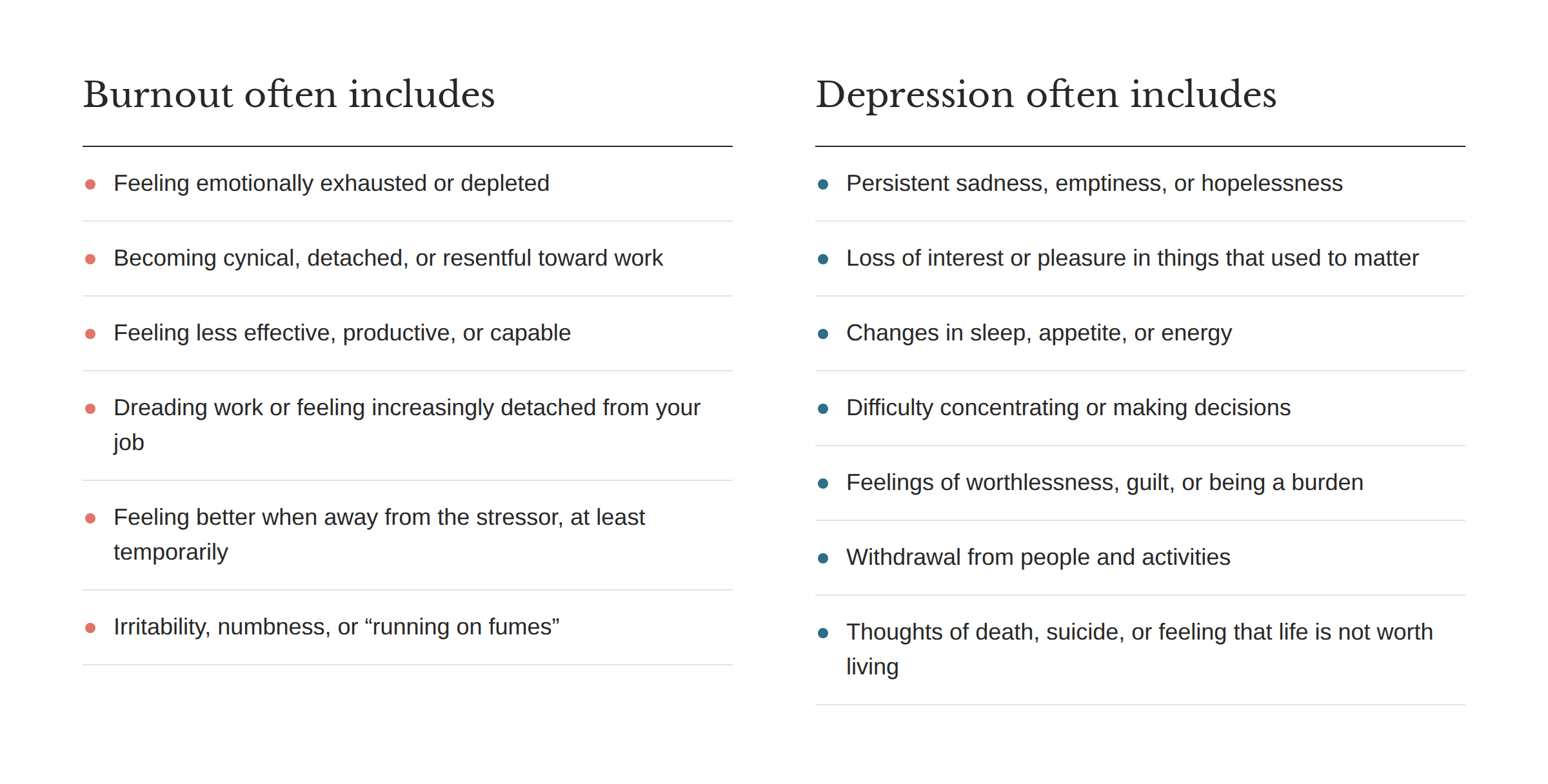
Burnout vs. Depression: How Therapy Helps with Both | Jericho Avery, LCSW
A practical difference is this: occupational burnout is work-specific, while depression is often more global. Burnout may be strongest when you think about work or your job responsibilities. Depression tends to spread across work, relationships, self-image, rest, and enjoyment.
That said, the line is not always clean. For example, someone may begin with work-related burnout and later develop depressive symptoms because they feel trapped, unsupported, or chronically ineffective. Another person may have depression that makes normal work demands feel impossible. Therapy helps sort through that complexity without reducing your experience to a label.
How Therapy Helps with Burnout
Therapy for burnout is not just about telling someone to “practice self-care.” That advice can feel insulting when someone is already overextended. Real burnout work usually involves identifying the demands, beliefs, boundaries, and systems that are draining the person.
Therapy may help you:
1. Identify the real source of depletion
In my work, I often find that burnout involves more than simply being busy. Two people can work the same number of hours and have very different levels of burnout. The difference may involve control, fairness, values conflict, lack of support, unclear expectations, perfectionism, financial pressure, or emotional labor.
A therapist can help you ask more precise questions:
What part of this situation is actually draining me?
Am I exhausted from workload, lack of control, emotional strain, or resentment?
What am I tolerating that I would not advise someone else to tolerate?
What belief keeps me from setting limits?
Those questions matter because the solution to burnout is not always rest. Sometimes it is role clarity, assertiveness, workload adjustment, grief work, career reevaluation, or learning to tolerate disappointing people.
2. Rebuild boundaries without unnecessary guilt
Burnout can become harder to interrupt when people repeatedly override their limits. This can happen to high achievers, clinicians, business owners, employees, and others who feel they cannot say no at work.
In therapy, boundaries can be treated as part of sustaining health and functioning, rather than as selfishness. Without workable limits, some people become increasingly resentful, numb, or ineffective.
Therapy can help you practice:
Saying no without overexplaining
Naming what is sustainable and unsustainable
Separating responsibility from overfunctioning
Reducing people-pleasing patterns
Creating recovery time that is protected, not optional
3. Challenge the beliefs that keep burnout alive
For some people, beliefs about productivity, responsibility, or disappointing others can help keep burnout going. Examples include:
“If I slow down, I’ll fall behind.”
“If someone is upset with me, I did something wrong.”
“My worth comes from being useful.”
“Rest has to be earned.”
“I should be able to handle this.”
Cognitive behavioral therapy and related approaches can help identify these thoughts and test whether they are accurate, useful, or sustainable. The goal is not forced positivity. The goal is clearer thinking and better choices.
4. Create a realistic recovery plan
Burnout recovery usually requires both internal and external changes. Internally, you may need better emotional regulation, self-compassion, and stress management. Externally, you may need to renegotiate responsibilities, reduce workload, change jobs, ask for support, or stop volunteering for every problem.
Therapy can help you build a plan that fits real life rather than an ideal life.
How Therapy Helps with Depression
Depression often makes people feel stuck inside their own mind. It can distort how they see themselves, their future, and their options. Therapy helps by creating structure, support, and a process for change when motivation is low.
Several forms of psychotherapy have evidence for helping depression, including cognitive behavioral therapy, interpersonal therapy, and psychodynamic therapy (American Psychological Association, 2024). The best fit depends on the person, their history, symptoms, preferences, and goals.
Therapy may help you:
1. Understand the depression pattern
Depression is not always loud. Sometimes it looks like irritability, withdrawal, procrastination, fatigue, emotional numbness, or loss of meaning. Therapy helps track the pattern rather than relying only on mood.
A therapist may help you examine:
When did this start?
What has changed in sleep, appetite, motivation, and social connection? What thoughts repeat when you feel low?
Are there unresolved losses, conflicts, transitions, or stressors?
Are there safety concerns, such as suicidal thoughts?
This matters because depression can become self-reinforcing. Low mood reduces action. Reduced action reduces reward and connection. Less reward and connection deepen the low mood. Therapy helps interrupt that cycle.
2. Rebuild action before motivation returns
One of the frustrating truths about depression is that waiting to “feel motivated” often does not work. Motivation often returns after small, repeated actions restart a sense of agency.
A therapist may use behavioral activation strategies to help you gradually re-engage with meaningful and necessary activities. This might include getting out of bed at a consistent time, walking outside, answering one message, attending one appointment, or returning to one valued activity in a small way.
The point is not to pretend everything is fine. The point is to create enough movement that depression has less room to dominate the day.
3. Work with painful thoughts more skillfully
Depression often brings harsh thoughts:
“I’m failing.”
“Nothing will change.”
“I’m a burden.”
“I should be further ahead.”
“People would be better off without me.”
Therapy helps slow these thoughts down and evaluate them. Are they facts, fears, old beliefs, emotional conclusions, or symptoms of depression? This distinction is important. A thought can feel true and still be distorted.
4. Address relationship and meaning struggles
Depression can be influenced by biological, psychological, and social factors. Loneliness, grief, conflict, shame, trauma, identity struggles, chronic stress, and loss of meaning may all be relevant to a person’s experience. Therapy gives space to explore these deeper layers.
For some people, depression improves when they learn better coping skills. For others, it improves when they finally tell the truth about what they have been carrying.
When Burnout and Depression Happen Together
Burnout and depression can feed each other. A person may become burned out from years of overworking, then start feeling hopeless because life feels like nothing but obligation. Another person may be depressed and then fall behind at work, creating more stress and shame.
When both are present, therapy usually needs to address both sides:
The external pressure: workload, roles, boundaries, conflict, support, schedule, financial strain
The internal experience: hopelessness, guilt, numbness, self-criticism, avoidance, loss of meaning
This is where a therapist can help you avoid overly simplistic answers. Burnout is not always solved by quitting your job. Depression is not always solved by thinking differently. Both require a careful look at what is happening inside you and around you.
A useful therapy goal might be: restore energy, reduce shame, clarify choices, and rebuild a life that is more psychologically sustainable.
My Perspective as a Therapist
I do not view burnout or depression as personal weakness. I view them as signals that something important needs attention. Sometimes that signal is saying, “Your life has too many demands and not enough recovery.” Sometimes it is saying, “You are carrying pain, hopelessness, or disconnection that needs care.” Sometimes it is both.
In therapy, I tend to look at the full picture: thoughts, emotions, behavior patterns, relationships, values, stressors, and the environment a person is living in. I am less interested in blaming the person and more interested in understanding the system they are trying to survive inside.
At the same time, therapy is not passive. Insight matters, but insight alone is usually not enough. Recovery often requires practicing new boundaries, changing routines, challenging distorted thinking, communicating more honestly, and making difficult but necessary decisions.
The goal is not just to feel better temporarily. The goal is to build a life that is harder to collapse under.
What to Do Next
If you are unsure whether you are experiencing burnout, depression, or both, therapy can help you sort through the difference. You do not need to have the perfect words before reaching out. It is enough to say, “I feel exhausted, disconnected, and not like myself.”
You may also consider speaking with a medical provider, especially if symptoms are severe, persistent, or affecting sleep, appetite, work, relationships, or safety. If you are having thoughts of suicide or feel unable to stay safe, call or text 988 in the U.S. for immediate crisis support, or go to the nearest emergency room. This article is educational and is not a substitute for diagnosis or individualized medical advice.
If this topic resonates with you, you can view my full profile on MiResource and reach out to see whether therapy feels like a good fit.
References
American Psychological Association. (2024). Depression and how psychotherapy and other treatments can help people recover.
Koutsimani, P., Montgomery, A., & Georganta, K. (2019). The relationship between burnout, depression, and anxiety: A systematic review and meta-analysis. Frontiers in Psychology, 10, 284.
National Institute of Mental Health. (n.d.). Depression. U.S. Department of Health and Human Services.
World Health Organization. (2019). Burn-out an occupational phenomenon: International Classification of Diseases.
World Health Organization. (2025). Depressive disorder (depression).